
The Entity Graph
Why an entity graph?
Section titled “Why an entity graph?”PDTF v1 represents a property transaction as a single monolithic JSON document — approximately 4,000 paths covering everything from the seller’s name to the flood risk assessment. This made the schema comprehensive, but it also meant:
- Every credential contains everything. A conveyancer updating the completion date must issue a claim touching the same document as the EPC provider. There’s no separation of concerns.
- Data doesn’t survive the transaction. When a sale falls through, all that verified data — searches, EPCs, title information — is locked inside a transaction object. The next buyer starts from scratch.
- Verification is all-or-nothing. You can’t verify the EPC data independently of the title data. The trust model is coarse-grained.
PDTF 2.0 solves this by decomposing the monolithic schema into ten distinct entity types, each independently identifiable and independently verifiable.
The ten entities
Section titled “The ten entities”Five entities carry data. Five are relationship credentials: thin, signed assertions that link a party to a transaction and, in doing so, embody that party’s role.
| Entity | Identifier | What it represents |
|---|---|---|
| Transaction | did:web:host:transactions:{id} | This particular sale: status, milestones, offers, enquiries, contracts, chain position, and the roster of parties |
| Property | urn:pdtf:uprn:{uprn} | The physical property: address, features, energy performance, environmental data, legal disclosures |
| Title | urn:pdtf:titleNumber:{number} | The legal title: register extract, tenure, leasehold terms, encumbrances |
| Person | did:key:z6Mkh... | A natural person: name, contact details, verification status. Role-free. |
| Organisation | did:web:smithandco.law | A legal entity: law firm, estate agency, lender |
| SellerCapacity | urn:pdtf:capacity:{id} | The capacity in which a person or organisation sells (legal owner, executor, attorney…). Implies the Seller role. |
| Offer | urn:pdtf:offer:{id} | An offer to buy: amount, status, conditions, buyer circumstances. Implies the Buyer role. |
| Gift | urn:pdtf:gift:{id} | A gift of funds towards a purchase. Implies the Giftor role. |
| Representation | urn:pdtf:representation:{id} | One party instructed by another: a conveyancer acting for a seller, an agent acting for a buyer. Carries the kind of representation as its role. |
| TransactionRole | urn:pdtf:role:{id} | A party’s role where no more specific relationship applies: lender, landlord, tenant, surveyor, platform support. |
Each entity becomes the credentialSubject of a W3C Verifiable Credential, signed by an authorised issuer and independently verifiable.
Roles live on the credentials
Section titled “Roles live on the credentials”In v1 every party sits in a flat participants[] array with a role string. PDTF 2.0 keeps a roster on the Transaction, but the roster carries only what stays true of a party regardless of any relationship: their DID, a transaction-local id, and the firm they work for. Role is stored nowhere else than on the relationship credential that embodies it.
| Credential | Asserts | Role |
|---|---|---|
SellerCapacity | this person sells, in this capacity | implied: Seller |
Offer | this person made this offer | implied: Buyer |
Gift | this person gifts funds towards a purchase | implied: Giftor |
Representation | this party is instructed by that party | explicit: which kind of representation |
TransactionRole | this party takes this role | explicit: which role |
For the first three the role follows from the credential’s existence. Representation and TransactionRole each span several roles, so they carry role as their own discriminator: acting for a seller tells you the side, not whether the party is the conveyancer, the agent or the surveyor.
Every participant with a role holds exactly one role-bearing credential: the specific one where a relationship exists, TransactionRole otherwise.
Why role is not on the participant
Section titled “Why role is not on the participant”Because a second copy would not be revoked. Firing a conveyancer means revoking their Representation. If the transaction also recorded “Seller’s Conveyancer” against that participant, revocation would remove the relationship and leave the role assertion standing: two sources of truth, disagreeing, with the stale one still readable.
Dropping a credential from the graph therefore gives back a transaction in which that party has no role and no relationship — which is exactly what revocation should mean.
Buyers and sellers
Section titled “Buyers and sellers”A core design principle of the graph is that the two intents in a sale are expressed by different credentials:
- Transaction = intent to sell. The Transaction represents the seller’s active intent to sell the referenced Property and Title(s). The seller’s
SellerCapacityembodies that. - Offer = intent to buy. An
Offerrepresents a buyer’s intent to purchase. Buyers participate only through Offers; a transaction can carry several, reflecting the real process of accepting and rejecting them.
Everyone else is linked to the party they act for. A buyer’s conveyancer holds a Representation whose represented party is the buyer; the buyer’s link to their offer is the Offer credential itself. That keeps Offer ⇒ Buyer exact: a giftor contributing funds towards an offer is linked to it through Gift, not Offer.
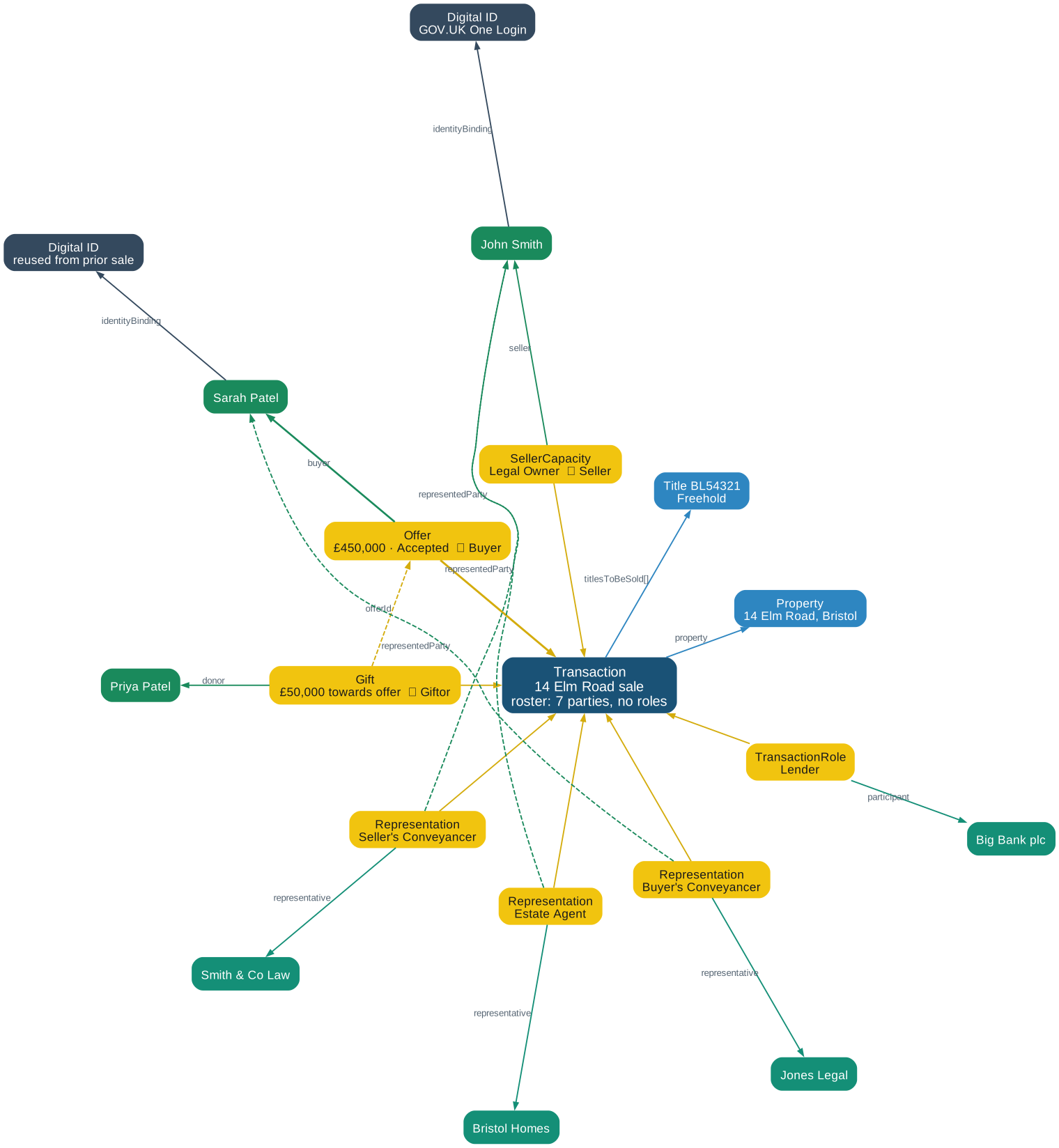
A worked example: the seller’s SellerCapacity, the buyer’s Offer, a parent’s Gift, three Representations and the lender’s TransactionRole all reference the Transaction. Each is a separate credential that can be presented, or revoked, on its own.
Access control and traversal
Section titled “Access control and traversal”Because every relationship is a credential that references the Transaction, the graph itself is the access model. No central ACL is required. A party asking for transaction data presents the credential that ties them to it: a conveyancer presents their Representation, a lender their TransactionRole, a buyer their Offer. The holder of the data validates the chain — this Representation names a party who holds an accepted Offer on this Transaction — and decides what to release. How scoped, time-limited consent should sit on top of this is an open consultation question.
The governing principle
Section titled “The governing principle”The decomposition follows a simple test — the Logbook Test:
Relationship credentials (SellerCapacity, Offer, Gift, Representation, TransactionRole) are thin assertions linking people and organisations to the sale. They carry just enough data to express the relationship, and are revocable when circumstances change.
Transaction-centric graph
Section titled “Transaction-centric graph”The Transaction is the root of the entity graph. All other entities are referenced from it, and every relationship credential references it back:
Transaction (did:web) ← intent to sell├── property → Property (urn:pdtf:uprn)├── titlesToBeSold[] → Title (urn:pdtf:titleNumber)├── participants[] ← roster: DID, local id, firm. No roles.│ └── → Person (did:key) / Organisation (did:web)├── offers{} ← offer terms, keyed by offer id││ relationship credentials, each referencing the Transaction:├── SellerCapacity seller → Person (implies Seller)├── Offer buyer → Person, offerId (implies Buyer)├── Gift donor → Person, offerId (implies Giftor)├── Representation representative → representedParty, role└── TransactionRole participant, roleThis is deliberate. The Transaction provides the context — this sale of this property — and the graph fans out to the entities involved. But each data entity exists independently of the Transaction and can participate in multiple transactions over time.
Entity deep-dives
Section titled “Entity deep-dives”Transaction
Section titled “Transaction”The Transaction is the only entity that uses did:web as its primary identifier. This means:
- The Transaction has a resolvable DID document
- The DID document contains service endpoints for API access
- Agents and systems can discover how to interact with the transaction by resolving its DID
The Transaction carries sale-specific metadata: status, milestones, offers, enquiries, contract data, chain position, and the residual sale-level ownership facts (saleContext: outstanding mortgage, Help to Buy status, number of sellers). It references the Property and Titles by URN, and lists its parties in an ordered roster.
Property
Section titled “Property”The Property entity represents the physical property and carries everything that would go in a “property logbook” — data that persists across transactions:
- Address and location — UPRN, coordinates, full address
- Physical characteristics — property type, construction, bedrooms, bathrooms, parking
- Energy performance — EPC data, ratings, recommendations
- Environmental data — flood risk, subsidence, contamination, radon
- Legal disclosures — TA6 (property information), TA7 (leasehold information), TA10 (fittings)
- Searches — local authority, environmental, drainage, mining
The Property is identified by its UPRN (urn:pdtf:uprn:{uprn}), which is a stable, nationally unique identifier for every addressable location in the UK.
The Title entity represents the legal title registered at HM Land Registry:
- Title number — the unique identifier
- Register extract — proprietorship, charges, restrictions
- Tenure — freehold, leasehold, commonhold, managed freehold
- Leasehold terms — if applicable: lease length, ground rent, service charges, management company
- Encumbrances — easements, covenants, notices
A single Property can have multiple Titles (e.g. the freehold and a long leasehold), and a single Title can cover multiple Properties. The relationship is many-to-many, managed through the Transaction’s references.
Person
Section titled “Person”A Person entity represents a natural person. Critically, it is role-free. A Person has no inherent role in a transaction — their role is determined entirely by the relationship credentials that reference them:
- Referenced by a SellerCapacity → they’re selling
- Referenced by an Offer → they’re buying
- Referenced by a Gift → they’re gifting funds
- Referenced by a Representation as the representative → they’ve been instructed; as the represented party → they’ve instructed someone
A Person’s did:key is minted once and is stable across transactions. Someone selling one property and buying another appears in two transactions as the same subject: one wallet, accumulating credentials, not one identity per participation.
Organisation
Section titled “Organisation”An Organisation represents a legal entity — a law firm, estate agency, lender, or other corporate participant. Organisations use did:web identifiers, allowing them to host DID documents with service endpoints.
Organisation is the one entity that stands outside the mechanical v3 round trip: the roster records a participant’s firm by name and reference, and resolving the participant’s DID gives the Organisation.
SellerCapacity
Section titled “SellerCapacity”SellerCapacity is a thin credential — a signed assertion of the capacity in which a person or organisation is acting to transfer title: legal owner, personal representative for a deceased owner, attorney under a power of attorney, mortgagee in possession, company director, trustee.
{ "credentialSubject": { "id": "urn:pdtf:capacity:abc123", "seller": "did:key:z6MkhSellerDID", "transaction": "did:web:platform.example.com:transactions:tx-789", "sellersCapacity": { "capacity": "Legal Owner" }, "dateBecameOwnerOrAuthority": "2014-06-01" }}It carries no duplicated data from either the Person or the Title. It simply asserts the relationship. Verification happens by cross-referencing the claim against the Title’s register extract (proprietorship data). It is scoped to the transaction, since the Transaction already lists the titles being sold; an optional title reference narrows it where a sale involves several.
One SellerCapacity is issued for every seller, whether or not a capacity has been declared yet, so the credential embodying the Seller role is never missing while a form is still being filled in. It is revocable — essential for when property changes hands.
An Offer links a buyer to a Transaction. It captures offer amount, currency, status (pending, accepted, rejected, withdrawn), inclusions, exclusions, conditions, and buyer circumstances (first-time buyer, chain position, mortgage status).
{ "credentialSubject": { "id": "urn:pdtf:offer:off-j1k2l3", "buyer": "did:key:z6MkhBuyerDID", "transaction": "did:web:platform.example.com:transactions:tx-789", "offerId": "o1", "amount": 450000, "currency": "GBP", "status": "Accepted" }}Buyers exist in the transaction graph only through Offers — there is no separate “buyer participation” entity. A prospective buyer who has not yet made an offer can still be represented, because Representation links to the person, not the offer.
A Gift records that a person is contributing funds towards a purchase: the terms a conveyancer has to resolve before reporting to a lender (whether the gift is repayable, whether the giftor will have an interest in the property, and so on).
{ "credentialSubject": { "id": "urn:pdtf:gift:g1", "donor": "did:key:z6MkhParentDID", "transaction": "did:web:platform.example.com:transactions:tx-789", "offerId": "o1", "giftDetails": { "repayable": false, "confersBeneficialInterest": false } }}The link from giftor to offer lives here rather than on Offer, so that an Offer credential always identifies a buyer.
Representation
Section titled “Representation”Representation is a thin credential that records one party being instructed by another:
{ "credentialSubject": { "id": "urn:pdtf:representation:def456", "representative": "did:key:z6MkhConveyancerDID", "representedParty": "did:key:z6MkhSellerDID", "role": "Seller's Conveyancer", "transaction": "did:web:platform.example.com:transactions:tx-789" }}There is one Representation per (representative, represented party) pair. A conveyancer instructed jointly by two sellers holds two, each presentable or revocable on its own. A separated couple instructing their own conveyancers yields one each — the case the old role-only model could not express at all.
The retainer is with the client, so a conveyancer is instructed by a person, not by an offer. The representative is the party who was instructed; the firm they work for is recorded on the Transaction roster, because where someone works does not stop being true when a representation ends.
Like SellerCapacity, it’s revocable — because clients can and do change solicitors mid-transaction.
TransactionRole
Section titled “TransactionRole”Some parties take a role in a sale without a relationship to a specific other party: the lender, a landlord or tenant, a surveyor instructed by nobody in the graph, platform support. TransactionRole asserts participation in that role.
{ "credentialSubject": { "id": "urn:pdtf:role:r1", "participant": "did:web:bigbank.co.uk", "role": "Lender", "transaction": "did:web:platform.example.com:transactions:tx-789" }}It is also the fallback while a more specific relationship is not yet established, so that every party carrying a role has exactly one credential embodying it.
ID-keyed collections
Section titled “ID-keyed collections”Entity collections in the v4 schema use ID-keyed maps, not arrays:
{ "properties": { "urn:pdtf:uprn:123456789": { /* Property entity */ } }, "titles": { "urn:pdtf:titleNumber:ABC12345": { /* Title entity */ } }}This enables:
- Deterministic addressing — credential subjects reference entities by their ID
- Merge semantics — updates target a specific entity by key, no index fragility
- Graph traversal — follow references by ID without relying on array positions
Where v3 array order carried meaning, it lives on the Transaction: titlesToBeSold and participants are ordered reference lists, authoritative for recomposition. No position is written into the entity documents themselves, so a credential never carries an index that could diverge from another producer’s.
From monolithic to graph: the transformation
Section titled “From monolithic to graph: the transformation”The entity decomposition is a mechanical transformation, not a creative redesign. Every path in the v3 monolithic schema maps to exactly one place in the v4 graph, by longest-prefix rule:
| v3 path | v4 destination |
|---|---|
propertyPack.titlesToBeSold[*] | Title |
propertyPack.ownership.ownershipsToBeTransferred[*] | Title (correlated with the above by titleNumber) |
propertyPack.ownership.* (the rest), propertyPack.legalOwners | Transaction.saleContext |
propertyPack.* (everything else) | Property |
participants[*] — party facts | Person |
participants[*] — transaction-scoped identity and firm | Transaction.participants[] |
participants[*] — role and relationship fields | SellerCapacity, Offer, Gift, Representation, TransactionRole |
| everything else | Transaction |
The mapping is generated, published alongside the schemas as a manifest, and checked at build time: a v3 field with no home in v4 is a hard error rather than a field that silently disappears. The State Assembly specification defines both composeV3StateFromGraph() (backward-compatible reassembly) and composeV4StateFromGraph() (new ID-keyed format).